Preserving Legacy and Sovereignty: Lessons from Oba Ovonramwen and the Kingdom of Benin’s Cultural Heritage
To build a legacy that matters, you must first understand the true cost of preserving one. For the successful Diaspora Leader who has already built a profitable enterprise, or the Multi-Generational Family Business proudly marking its half-century, the next great challenge isn’t profit, it’s permanence. It’s the monumental task of packaging decades of accumulated wisdom, struggle, and triumph into an asset that future generations can inherit, use, and defend.
Learn How to Leverage Your Story through our Story To Asset Framework.
Nowhere is this battle for permanence more powerfully illustrated than in the story of one of Africa’s last truly independent monarchs: Ọba Ovọnramwẹn Nọgbaisi of the Kingdom of Benin.
His reign was the final, brilliant flare of a centuries-old empire, a story of resistance that speaks volumes about the value of sovereignty, cultural heritage, and the indelible nature of a well-told legacy.
The Rising Sun: The Kingdom at the Pinnacle
When Prince Idubor was crowned as the 35th Ọba of Benin in 1888, he chose the formidable throne name, Ovọnramwẹn Nọgbaisi. The name itself was a statement of destiny: “The Rising Sun which spreads over all.”
At the close of the 19th century, the Kingdom of Benin (not to be confused with the modern Republic of Benin) was a sovereign powerhouse in West Africa. For centuries, its highly structured political system and formidable army had maintained its independence against European encroachment, a feat few other kingdoms could claim.
The Ọba held a near-absolute monopoly over trade, a critical point of friction with the encroaching British Empire. Influential investors coveted the kingdom’s rich natural resources: palm oil, rubber, and the prized ivory. But the most valuable asset was its long-standing, meticulously organized society and the priceless cultural heritage it produced.
The kingdom was not a static entity; it was a complex economic and artistic hub. While the historical record, as cited in sources like Richard E. G. O. Egharevba’s A Short History of Benin, confirms the kingdom’s role in the slave trade centuries before, by the time of Ovọnramwẹn, the focus had shifted significantly to a monopoly over legitimate commerce, which the British sought desperately to dismantle.
By the 1890s, the Kingdom of Benin was one of the few remaining independent states in the region, a testament to the power of a stable, long-term governance structure, the ultimate multi-generational business model.
The Asset: Heritage as Economic and Cultural Gold
The true legacy of Benin, which today is undergoing a global repatriation struggle, lay in the city’s masterful artistry—the Benin Bronzes.
These thousands of brass plaques, sculpted heads, and other intricate figures were not mere decorations. They were the kingdom’s living archive. Crafted by the highly skilled Igun Eronmwon guild, these pieces meticulously recorded the history, rituals, and lineage of the kingdom, serving as a political and social database for the royal court.
- For the Family Business: These bronzes are the perfect analogy for your company’s heritage. They are the tangible assets, the unique methods, the secret processes, the decades of specialized knowledge that only your family holds. They justify your premium price and build unshakeable trust.
- For the Diaspora Leader: Your 20+ years of expertise is your own collection of bronzes. It is the proprietary knowledge you’ve developed that solves a specific problem for your clients—the unique methodology that needs to be packaged and protected.
Oba Ovọnramwẹn was the protector of this heritage. His refusal to cede full control over trade was not just an economic decision; it was the defense of Benin’s sovereignty, its cultural integrity, and its historical right to self-determination.
The Defense: The Price of Preserving Sovereignty
The inevitable conflict arrived in 1897. British officials, like Vice-Consul James Robert Phillips, were determined to annex the territory. In late 1896, Phillips embarked on a controversial “negotiating” expedition to Benin City, reportedly with hidden weapons and troops disguised as porters, as noted by Sven Lindqvist in Exterminate All the Brutes.
Oba Ovọnramwẹn’s messengers issued several warnings, stating the Ọba was unavailable for ceremonial duties and that the delegation was violating territorial sovereignty.
Despite these warnings, Phillips pressed forward, even sending his stick ahead, a deliberate, grave insult designed to provoke. The Ọba’s generals, perceiving the advance as a clear attempt to depose their ruler, unilaterally ordered an ambush. The attack was swift and deadly, killing most of the British party.
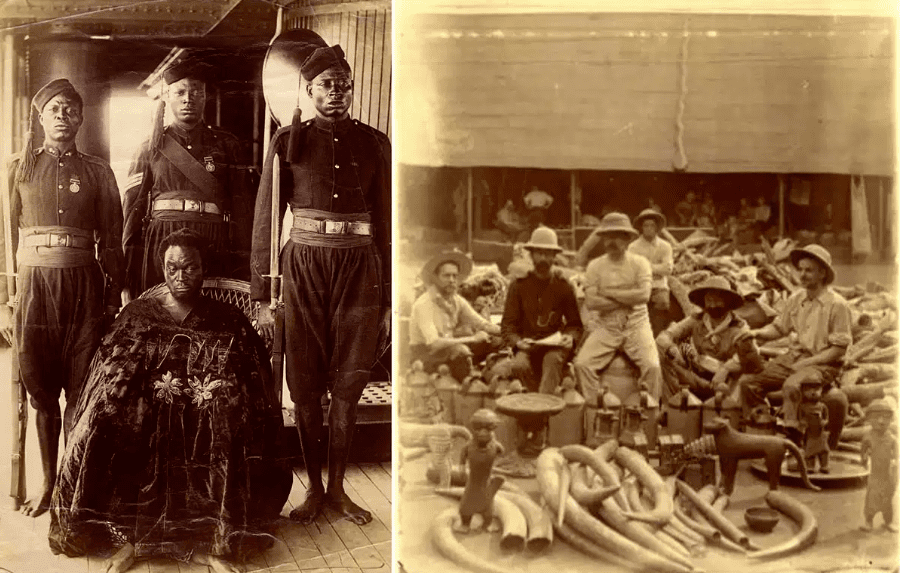
The retaliatory British Punitive Expedition that followed was devastating. In February 1897, the British force led by Sir Harry Rawson descended upon Benin City. The city was razed, its fortifications destroyed, and the royal palace looted. Thousands of the invaluable Benin Bronzes were taken as war booty, dispersing Benin’s history across museums and private collections in the West.
The destruction of Benin City was more than a military victory; it was an attempt to erase a legacy. It was the calculated removal of the central narrative and its physical assets.
The Exile and The Unbroken Spirit
After six months of evading capture in the forest, Oba Ovọnramwẹn made the choice to return and formally surrender on August 5, 1897. Even in defeat, he carried the weight of his office.
He returned richly dressed, laden with coral beads, and escorted by an entourage of seven to eight hundred people. This was not the surrender of a beaten man; it was the appearance of a King upholding the dignity of his lineage until the very last moment.
He was exiled to Calabar, where he lived with two of his wives, Queen Egbe and Queen Aighobahi. He spent his final years hosted by Etinyin Essien Etim Offiong in Essien Town, a foreign land but still within the larger currents of the Nigerian coast.
He died around 1914, having never fully relinquished his title. He was eventually buried in the grounds of the royal palace in Benin City, a prove to the enduring reverence for his office. His son, Prince Aguobasimwin, eventually succeeded him as Eweka II, ensuring the unbroken lineage of the Benin monarchy continued, even in altered form.
You might also like Legacy and Leadership: How Oba Erediauwa’s Story Merges Ancient Traditions with Modern Governance for Diaspora and Family Businesses
The life of Oba Ovọnramwẹn Nọgbaisi is the ultimate legacy lesson:
- What you build will be coveted: Your unique methodology, your family’s craft, your decades of expertise, it’s all valuable. You must be prepared to defend it.
- Narrative is Power: The British stole the Benin Bronzes because they knew those objects told the authentic story of the Kingdom. By controlling the narrative, they controlled the perception. The Kingdom’s story outlived its destruction because the truth of its culture was too deeply ingrained to be completely erased.
Today, the ongoing push for the repatriation of the Benin Bronzes is a global fight for justice and, critically, for the restoration of a cultural and historical legacy that belongs to its rightful owners. It’s a reminder that a legacy is not truly yours until you have fully claimed and packaged its story.
The Unveiling: Packaging Your Indelible Story
You, the Established Diaspora Leader or the Multi-Generational Family Business, stand at a similar crossroads. You have built your own empire, your brand, your fortune, your expertise. Now, you must secure its permanence.
Oba Ovọnramwẹn’s greatest strength was his unyielding commitment to his royal heritage. What is your unyielding commitment? What is the core of your proprietary knowledge that needs to be immortalized, protected, and leveraged?
This is where the principles of AClasses Academy come in. We don’t just write a history; we transform your life’s work into an undeniable, defensible asset.
- Transforming Wisdom into Proprietary Solution (The Legacy Signature Program): We take your 20+ years of expertise, your unique way of solving client problems, and codify it as your brand’s exclusive methodology, your proprietary solution that no competitor can copy.
- Immortality as a Book (The Legacy Book): Like the Benin Bronzes that recorded the royal history, we craft your story and expertise into a definitive, authoritative book. This is your personal charter, making you the undeniable authority in your industry and providing a timeless message for the next generation.
- Shaping Your Narrative in Motion (The Legacy Video): A picture may be worth a thousand words, but a cinematic video of your story is your truth immortalized. We translate your ‘why’ and your journey into a premium marketing asset that connects your brand to generations, ensuring your narrative is shaped by you, not by others.
Your legacy is your most valuable asset. Before you print another brochure, let’s talk about how to immortalize it. Book your free 15-minute Legacy Strategy Call today to design the asset that will tell your story for the next 50 years. Book Your Free 15-Min Legacy Call Now