The Architects of Time – Reclaiming the Intellectual Throne of the Diaspora
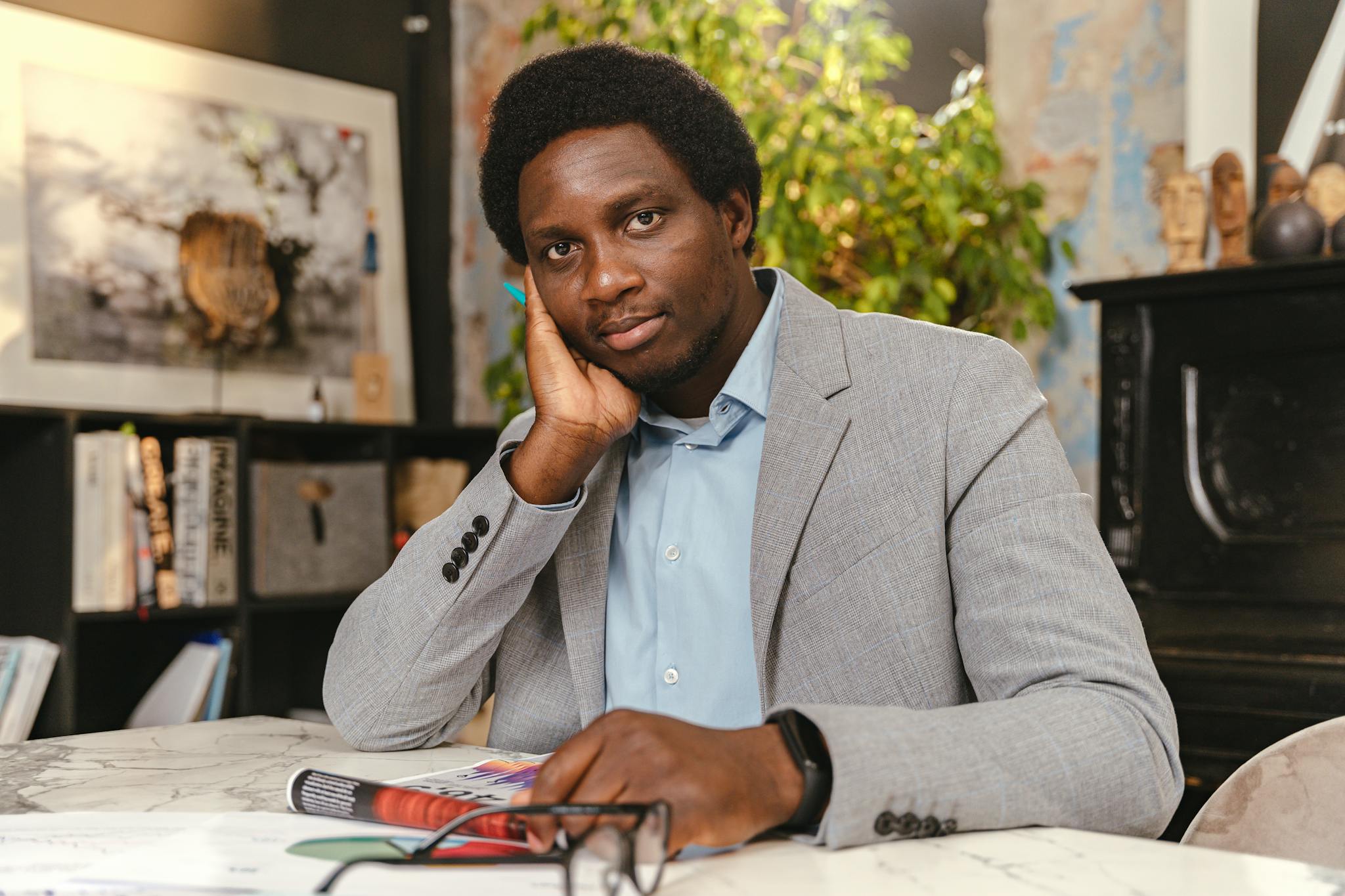
In the globalized economy of 2026, the Diaspora professional often operates within a framework of knowledge that is not their own. We are taught to be “mimes” of a Western ideal, forgetting that the very foundations of the systems we serve, mathematics, architecture, and governance, were born in the soil we left behind.
Learn How to Leverage Your Story through our Story To Asset Framework.
As Mohamed BA, celebrated cultural researcher and lead instructor at AClasses Academy, argues: “Dakar isn’t Paris. Amadou isn’t François. To build a future that is truly ours, we must first architect a new understanding of our past.”
Below, we step into the classroom to hear directly from Mohamed BA as he dismantles the colonial narrative and reconstructs the “Social Architecture” of the African Diaspora.
The Black Nile: Beyond the Island of the Desert
“Good morning everyone,” Mohamed begins, his voice resonant with the weight of history. “We are told that Egypt is an island in the desert, a ‘civilized’ space separated from the rest of Africa. This is the first lie we must unlearn. In this course, we restore the Nilotic Logic of civilization.”
Mohamed points to the 25th Dynasty, the Black Pharaohs who ruled both Egypt and Sudan. For him, this isn’t just a fact; it is a shield against the “unconsciousness” of our own value.
“The Nile flows from the south to the north. Culture, religion, and technology descended along that river. Nubia, what the locals called Kush, was not just a neighbor to Egypt; it was its brother, its cradle, and its warrior spirit. Before the Pharaohs of the north, there was Kerma, 2500 years before Christ. It was an economic empire based on gold and ebony, with an architecture that didn’t copy anyone.”
See his course The Cosmogonic of African Empowerment & Identity Sovereignty
He describes Taharqa, the most famous of this dynasty, mentioned even in the Bible for his military might. Under the Black Pharaohs, Egypt didn’t just survive; it experienced a Renaissance. They rebuilt temples and revitalized the hieroglyphics.
“When you look at an Egyptian monument,” Mohamed insists, “do not see something ‘strange’ or ‘foreign.’ See the African genius responding to the challenges of its environment. This is your heritage. This is what gives you the strength to keep your back straight in a world that wants you to bend.”
Aksum: The Lighthouse of the Ancient World
Moving to the east, Mohamed introduces Aksum (modern-day Ethiopia), a kingdom so powerful that the Persian prophet Mani ranked it alongside Rome, Persia, and China as one of the four superpowers of the earth.
“Aksum was the bridge between Rome and India,” Mohamed explains. “It was not an isolated tribe; it was a geopolitical hub.” He highlights two critical “Logic Hits” from the Aksumite Empire:
- Monetization as Sovereignty: Aksum was the first African state to mint its own currency in gold, silver, and bronze. “To mint your own coins,” Mohamed notes, “is to declare economic independence. It was written in Greek for commerce and Ge’ez for the soul.”
- Intellectual Christianity: Around 330 AD, King Ezana adopted Christianity. “This was not an act of conquest,” Mohamed reminds us. “It was a strategic, aristocratic, and intellectual choice. It created a national faith that allowed Ethiopia to remain the only African nation never permanently colonized.”
He points to the Obelisk of Aksum in Rome; a monument Mussolini stole in 1937 and only returned in 2005. “We must transform these monuments from ‘war-booty’ into testimonies of our technological and spiritual presence in the world.”
The Empires of Gold: Trust as an Economic Asset
In West Africa, the empires of Ghana (Wagadu) and Mali established models of governance that the world is still trying to replicate.
The Mute Barter of Ghana
“In the Land of Gold,” Mohamed says, “wealth didn’t just come from mines; it came from the ability to tax and protect trade.” He describes the Mute Barter, a system where merchants exchanged gold and salt without direct contact, based entirely on trust and pre-established rules.
“Think of the sophistication required to link nations that didn’t even speak the same language through a system of silent trust. This was a bureaucratic miracle. In Ghana, the city was divided into administrative and religious quarters, managing multiculturalism with intelligence.”
Mansa Musa and the Silicon Valley of the 14th Century
When Mohamed speaks of Mansa Musa, the richest man in history, he doesn’t focus on the gold Musa distributed in Cairo. He focuses on the University of Timbuktu.
“Mansa Musa didn’t use gold just for prestige; he invested it in knowledge. Timbuktu was the Silicon Valley of the 14th Century. Scholars studied astronomy, medicine, and philosophy. We have thousands of manuscripts that prove Africa had a solid scientific tradition centuries before colonization. Wealth without culture is ephemeral. Musa chose to be remembered for his universities.”
The Urban Genius: Benin and Great Zimbabwe
“They tell you that Africa is a continent of straw huts,” Mohamed says with a defiant smile. “Let us look at the granite and the bronze.”
- The Walls of Benin: The Portuguese in 1485 were stunned to find a city with streets wider and cleaner than those in Europe, protected by 16,000 kilometers of bastions. “This was planned urbanism, reflecting a precise cosmological and social order.”
- The Great Zimbabwe: “Jinba-Mawe,” the House of Stone. Mohamed explains the incredible dry-stone technique; granite blocks fit together perfectly without a single drop of mortar or cement. “When Europeans saw it, they invented absurd theories that Phoenicians built it. They could not admit that Africans had mastered such geometry and statics.”
The Diplomacy of Congo and the Warrior Queens
Finally, Mohamed addresses the Kingdom of Congo and the power of the female leaders who shaped the continent.
Also 189 Restaurants To Pick From In Florence, Italy
“The King of Congo sent ambassadors to Lisbon, Rome, and Brazil in the 1400s,” he notes. “They corresponded with the Pope as peers. They were not prisoners of diplomacy; they were protagonists.”
He celebrates the Kandakes (Nubian Queens) and Nzinga Mbandi of Angola.
“Nzinga was a diplomat and a general. When the Portuguese denied her a seat to make her feel inferior, she made one of her soldiers a human throne and sat at the governor’s eye level. She fought the slave trade and the settlers for 80 years. This is the female power that is rooted in our DNA.”
Conclusion: The Responsibility of the Architect
Mohamed BA closes the lesson with a call to action for the Diaspora professional of 2026.
“Every immigrant is, in a sense, a hero who has completed an archetypal epic,” he concludes. “You have crossed borders, learned new languages, and you support the economies of two continents at the same time. This is not a necessity; it is an extraordinary performance.”
He reminds us that our strength isn’t just the tambourine or the dance, it is the Social Capital of Ubuntu (I am because you are) and Teranga (Hospitality).
“Do not stop at the ‘paint’ of the stereotype. Recover your vital space. Whether you are an employee in Italy or a manager in London, you are the bearer of an added cultural value. Authenticity is your greatest competitive asset. You are the bridge between worlds. You are an expert in complexity who knows how to walk where others stop.”
Enroll in the Full Masterclass: The Social Architecture of Being
This article is a glimpse into Course 2 of the Mohamed BA 10 course series. To truly move from being a “mime” of others’ stories to being the “architect” of your own, you must engage with the full curriculum.
Join us at AClasses Academy to:
- Access the full 10-course video series by Mohamed BA.
- Master the Forensic Inquiry of African Civilizations.
- Transform your historical knowledge into a Strategic Professional Asset.
About the Instructor: Mohamed BA
Mohamed BA is a Master of Social Architecture and a pioneer in the Pedagogy of the Encounter. A Senegalese-born playwright and author based in Milan, he helps Diaspora professionals transform their identity from “Mimes” of Western culture into “Architects” of their own global narrative.