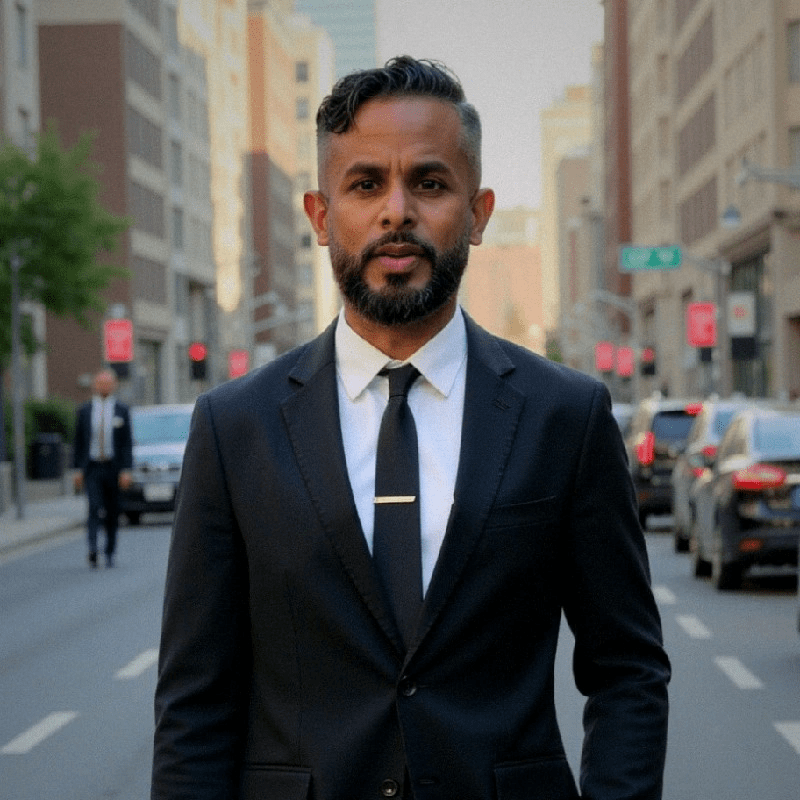
From Tenant to Sovereign: Reclaiming the Soul of African Education with Jeewan Chanicka
For the African Diaspora, education has often felt less like a bridge to freedom and more like a restrictive lease on someone else’s property. This condition, described by experts as “Economic Tenancy,” sees generations of brilliant minds operating within systems designed for an industrial revolution that never prioritized their humanity, their rhythm, or their ancestral survival.
Learn How to Leverage Your Story through our Story To Asset Framework.
In a recent dialogue between Jeewan Chanicka, a Leadership and System Transformation strategist, and host Obehi Ewanfoh, the two deconstructed the “miseducation” plaguing the Diaspora.
Their conversation was a call to move beyond the status of a “Subject” of Western institutions and step into the role of a Sovereign of one’s own legacy.
As the African proverb reminds us: “Until the lions tell their own historians, the history of the hunt will always glorify the hunter.” The mission now is for the lions to write the syllabus.
The Historical Context: The Architecture of Erasure
For centuries, the Western model of schooling was designed as an annex of the factory. Its primary goal was to create compliant cogs, individuals who follow bells, respect rigid hierarchies, and perform repetitive tasks without questioning the “why.”
For the Diaspora, this architecture was even more insidious because it didn’t just demand compliance; it demanded erasure.
Chanicka, reflecting on his upbringing in Trinidad, pointed to the absurdity of this “Digital Tenancy” within the curriculum:
“I’m talking about high tea and snow. And guess what? We don’t have high tea or snow in Trinidad… but it’s in the books though. I was a kid who grew up climbing mango trees and running on the beach, and there were things in my experience that weren’t reflected in the book. So, we end up erasing ourselves.”
This represents the “Institutional Barrier” in its purest form. When a child’s reality is excluded from their education, the subconscious message is clear: Your life is not a subject worthy of study. Chanicka noted that this erasure leads to a devastating psychological cost:
“Inherently, what we are teaching our children is that they aren’t valuable. My skin color needs to be lighter, my nose needs to be more straight, I need to be speaking only a particular language.”
The result is a generation that is “educated” in the eyes of global institutions, yet “ignorant” of the very assets that ensured their ancestors’ survival for millennia.
The Pain Point: The Educated Ignorant
A central theme of the discussion was the widening “deficit” between modern schooling and local survival. In traditional African contexts, education was inseparable from the environment.
When a child was sick, they witnessed a grandmother walk into the forest, an expert without a Western PhD but possessed a “Sovereign Asset”: the knowledge of the land. She could gather fifteen different leaves and barks, and within hours, the fever was gone.
Today, the Diaspora sends its children to the “best” schools, yet many walk past those same leaves every day without knowing their names or their power. Ewanfoh observed this paradox:
“When you become educated [in the current system], you become ignorant. You don’t know the name of the plant. If they give you the leaves, you don’t know. Yet you are living in this place.”
This is the logical outcome of a system that views students as products for export rather than leaders for their own soil. It represents a form of “Economic Tenancy”—paying the high price of an education only to live in a mental house owned by someone else.
The “Restoring the Circle” Formula
To transition from “Tenant” to “Sovereign,” the community must identify the Decoding Formula that breaks the industrial mold. Chanicka highlighted a staggering irony: while medicine, technology, and agriculture evolve with data, education remains the “anomaly” that refuses to move.
“We would never go to a doctor or a hospital where they’re doing things the way they did it 100 years ago… But that’s not what we do in education. We’re still pushing kids into rooms, grouping them by age, and teaching them to memorize facts.”
The formula for breakthrough lies in “Restoring the Circle”—a shift from the linear “assembly line” to a human-centric, communal ecosystem.
1. Ability Over Age
In the industrial model, products are grouped by “batch number” (age). Chanicka argues this is fundamentally flawed:
“We are still putting children in classes based on their age, not based on their ability… We should be creating environments where children can excel in what they are really good at.”
2. Inquiry Over Memorization
In an AI-driven world, facts are commodities. The true “Sovereign Asset” is the ability to think critically. Chanicka shared a success story from his tenure as a principal where he phased out textbooks in favor of Inquiry-based learning. They gave students complex problems that lacked easy answers.
“The stuff the students started to produce, the ways they started to connect to their community… it was absolutely mind-blowing. Our scores started to go up while everyone else’s were going down.”
3. The Teacher as “Morabbi”
True education requires moving from the “instructor” model back to the ancestral concept of the teacher as a “nurturer of the spirit.” Chanicka referenced the concepts of Muallim and Morabbi:
“That wasn’t just somebody teaching knowledge… You’re also nurturing the spirit of the person in front of you. How are we preparing them to live their best lives in a way that understands the way we are connected to one another, the land, and the water?”
The “Story-to-Asset” Methodology: Codifying Genius
The conversation underscored a proprietary approach: the Story-to-Asset methodology. This framework posits that lived experience, one’s personal and ancestral “story”, is not merely a memory; it is intellectual property that must be codified into a valuable asset.
Ewanfoh reflected on the urgency of this, noting that out of over 1,000 interviews he has conducted, several participants have since passed away.
“If I didn’t interview this person… this information wouldn’t be here. A son or daughter will ask, ‘How did my grandpa look?’ This might be the only record they have.”
When the Diaspora records its stories, it is building a Fortress of Peace. It ensures that the next generation does not start from zero.
By codifying “Sovereign Truths”—how to lead, how to heal, how to build—the community creates digital assets that can be studied, monetized, and scaled across the globe.
A Blueprint for the Next Generation
The ultimate “So What?” of this dialogue is clear: how does this information help a family own its genius and protect its future? Chanicka warned that the Diaspora cannot wait for governmental permission to change.
“Is there a political will for this? My experience has been there is not… we’re too invested in the way things have always been. We need to start doing this organically.”
To achieve Institutional Sovereignty, individuals must treat education as a “Sovereign Asset” rather than a passive service. Blueprint for Implementation:
- Audit the Educational Diet: Move away from curricula that only prepares the individual to be a “worker” for external systems.
- Codify Personal Mastery: Identify skills that aren’t in textbooks—leadership styles, community management, or ancestral knowledge—and turn them into documented assets using the Story-to-Asset method.
- Leverage Diaspora-Led Platforms: Support and utilize educational platforms like AClasses Academy, where unique courses are created by and for the Diaspora community, focusing on self-improvement and system-building.
Closing: The Shoulders of Giants
Chanicka concluded with a vision of intergenerational responsibility: “A young man looked at me last night and said, ‘You walk so we could run.’
See also 6 success habits of Elon musk you can apply today in your business
That’s exactly it. We do our part in the scheme of things… we are the shoulders on which others will stand.”
The transition from “Tenant” to “Sovereign” is a journey of remembering. It is about ensuring that the next generation does not just “get a job,” but inherits a world where their humanity is the primary foundation of their excellence.