The Monopoly of Violence and the Architecture of Resistance: Decoding the Diaspora’s Narrative Sovereignty
Based on the Diaspora Storytelling Series session held yesterday, January 27, 2026, by moderator Obehi Ewanfoh and featuring Rev. Gloria Ogunbadejo, and Lateefat Odunuga. To download the full 3-page Event Brief and the “Sovereign Mindset Checklist” from this session, visit Diaspora Storytelling Series.
Learn How to Leverage Your Story through our Story To Asset Framework.
The global African Diaspora is currently witnessing a profound shift in the landscape of Western authority. On January 27, 2026, the Diaspora Storytelling Series convened on the escalating crisis of state power, immigration, and the dehumanization of the “other” in the United States.
What began as a discussion on the tactical violence of immigration enforcement evolved into a question of Institutional Sovereignty, a refusal to be defined by the “gaslighting” of the state, and a call to reclaim our ancestral and linguistic authority.
The Invisible Treadmill of Global Migration
Obehi Ewanfoh, founder of AClasses Academy, opened the session by framing migration not as a political debate, but as a fundamental human journey. For over a decade, Obehi has documented the lived experiences of Africans in the Diaspora, moving from the streets of Verona, Italy, to a global audience.
“Immigration is not just a Western affair; it is a human affair,” Obehi noted. “People move. But the politicians are often diabolical in how they approach this journey.”
The session highlighted a glaring hypocrisy: Western nations, particularly those with aging populations like Italy, desperately need the labor and vitality of immigrants, yet the political rhetoric treats these same human beings as disposable objects.
See also How African Festivals Connect Diaspora Communities and Strengthen Cultural Bonds
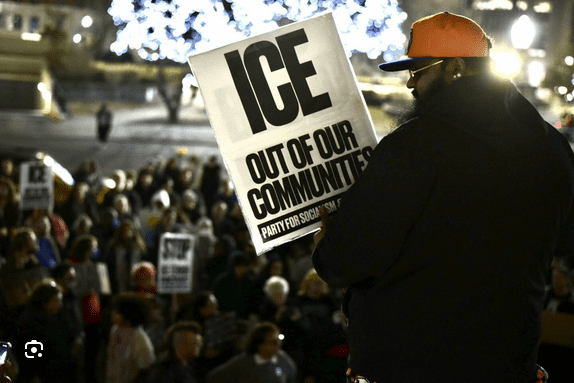
The discussion quickly pivoted to the United States, where the “Monopoly of Violence” has taken a specific, institutional form.
Obehi questioned the creation of specialized agencies like ICE (Immigration and Customs Enforcement) in a country that already possesses one of the most effective policing systems in the world. “Why create a different kind of police? It is as if they want to sideline the law to protect the law. But you cannot break the law to protect the law.”
Truth as the First Victim of State Terror
Rev. Gloria Ogunbadejo, an Ancestral Healing Coach, brought a spiritual and historical lens to the violence unfolding in cities like Minneapolis. She began by “calling in” the ancestors, those who survived borders, state terror, and displacement.
“When the state turns its force on everyday people, the first thing it attacks is not the body. It attacks truth,” Rev. Gloria stated. She described the current political climate as a “bottomless pit” where human lives are treated as disposable. The danger, she argued, is not just the individual leader in power, but the collective erosion of humanity.
“The moment you convince yourself that someone else’s suffering is irrelevant to you, you have already accepted the rules of dehumanization,” she warned.
This is a critical insight for the Diaspora: the violence used at the border today is the same violence that can be turned on the citizens tomorrow. History shows that these rules of dehumanization never stop where they begin.
Lying vs. Gaslighting: The Psychological Warfare
Lateefat Odunuga, a Corporate Storyteller and researcher, introduced a vital distinction into the conversation: the difference between lying and gaslighting.
Using a “sandwich analogy,” she explained that while a lie is a simple denial of a fact, gaslighting is an attempt to convince the victim that the reality they are experiencing doesn’t even exist.
“With this administration, they aren’t just lying; they are gaslighting us. They are encoding messages they want us to believe, telling us we don’t belong, that we will never have a seat at the table,” Odunuga explained.
She introduced her proprietary S.T.O.R.Y. Framework as a weapon of epistemic resistance:
- S (Source): Questioning where the story comes from.
- T (Tell): Telling your version of the truth.
- O (Ownership): Taking ownership of the narrative.
- R (Reframe): Reframing the story for personal and collective power.
- Y (Yield): Yielding the story back to the world as a tool of liberation.
This framework is essential for dismantling “epistemicide”, the systematic destruction of indigenous knowledge and the silencing of marginalized voices.
The Architecture of the Mask: Cultural Forensics
A powerful moment in the discussion occurred when Obehi linked the current political crisis to a “Cultural Forensic” audit he had conducted earlier that day. He discussed the “stolen” African masks sitting in the British Museum and Paris.
“The mask is not just art; it is a spiritual connection. It is a technology of the soul,” Obehi argued. The theft of these objects is a physical manifestation of the state’s desire to own African and the Diaspora’s narrative and history.
By sitting on “stolen goods” while claiming high moral ground, Western institutions display the same lack of integrity seen in modern immigration enforcement.
Resistance, therefore, must be multi-dimensional. It is not enough to protest on the street; we must reclaim the “Mask”, the symbols, the rituals, and the artifacts of our identity.
Linguistic Sovereignty: The Next Frontier
As the session drew to a close, the participants identified the ultimate border of the sovereign mind: Language. Obehi expressed his frustration with African leaders who address the United Nations in English or French, while Chinese, Arabic, and Russian leaders speak their native tongues.
“Who did this to us? Why can’t we be proud of who we are? We have millions of people who understand Yoruba, Hausa, or Igbo. Why do we treat our own tongues as ‘local’ and Western tongues as ‘universal’?”
Lateefat Odunuga echoed this, calling for “Semantic Sovereignty.” She highlighted a recent viral video of a brother teaching the Pythagoras Theorem in Yoruba.
See also The Role of African Festivals in Strengthening Diaspora Connections to Africa
This is the “Sovereign Shift” in action, using our own linguistic architecture to master global concepts. When we speak our own language, we aren’t just communicating; we are re-activating a “Fortress of Peace” within our own neurology.
Conclusion – The “Sovereign Bridge”
The January 27 session was a reminder that the Diaspora is not a collection of “Digital Tenants”, waiting for permission from the state. We are a “Sovereign Remnant” with the responsibility to author our own narratives.
The path forward is clear:
- Refuse the Label: We must reject terms like “illegal aliens” that seek to strip us of our humanity.
- Codify the Genius: Our stories, our languages, and our survival strategies must be turned into “Institutional Assets.”
- Build Our Own Table: As Rev. Gloria noted, “Healing is an act of responsibility.” We must build the Academy, the museums, and the educational systems that protect our “Knowledge.”
As we prepare for the next events on February 3rd, the charge remains: Stop renting your success. Start building your institution. Book Your Free 15-Minute Legacy Strategy Call Now