How Marcus Garvey’s Institutional Wisdom Shapes the Modern African Diaspora – George Goddard
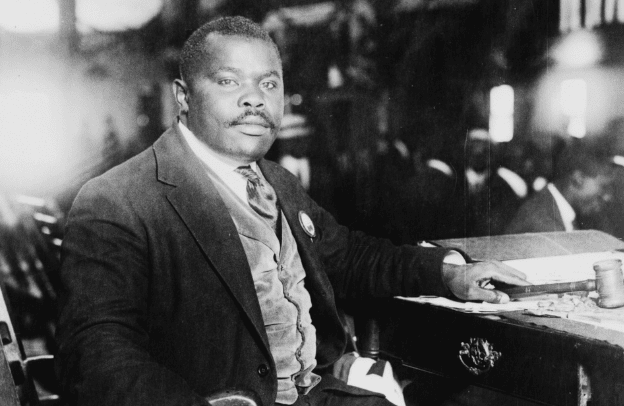
The journey from being a consumer of history to an architect of legacy begins with understanding the foundations laid by those who came before us. For the African Diaspora, few foundations are as solid or as daring as the life of Marcus Mosiah Garvey. In a world that often seeks to fragment our stories, Garvey’s life offers a “Golden Thread” of unity, self-mastery, and sovereign learning.
Is your story a liability or an asset? Take the 3-Minute Sovereign Audit to see if your legacy is secure.
This exploration into the life and legacy of Marcus Garvey is based on an in-depth conversation between Obehi Ewanfoh on The Obehi Podcast and George Goddard, an industrial relations practitioner, trade unionist, and poet from Saint Lucia.
See the full podcast interview: The Life & Legacy Of Marcus Mosiah Garvey (Jamaican Political Activist) with George Goddard
Together, they excavate the repeatable methodologies Garvey used to move a global population from oppression to a mindset of ownership.
Introducing George Goddard
To understand a giant like Marcus Garvey, one must view him through the eyes of those who carry on his spirit of activism. George Goddard is a practitioner of the very principles Garvey championed.
Based in Saint Lucia, Goddard has dedicated his life to industrial relations and trade unionism, holding an MBA with distinction from the Cave Hill School of Business at UWI Barbados. His background in labor rights gives him a unique lens to analyze Garvey’s organizational genius.
See also Barbados Prime Minister, Mia Mottley: Why the Diaspora is the New Global Superpower
Beyond the boardroom and the bargaining table, Goddard is a man of letters. As a published poet and writer, he understands the power of narrative and the importance of “Cultural Archaeology”, the act of digging into our past to find the tools for our future.
His insights provide the bridge between Garvey’s 19th-century beginnings and the 21st-century professional’s need for a “Generational Anchor.”
The Birth of a Black Nationalist: Roots in Saint Ann’s Bay
Marcus Garvey was born in 1887 in Saint Ann’s Bay, Jamaica, during a period where the echoes of slavery were still loud and painful. Although slavery had technically ended in the British West Indies by 1838, the social and economic conditions for black people remained largely unchanged.
They were free in name, but bound by a system that offered little bread for the table and even less hope for the future.
Garvey’s father was a significant influence, described by Goddard as an activist who spoke on political and trade union platforms. This was Garvey’s first encounter with “Institutional Wisdom.”
He saw that change required a voice. In school, young Marcus was known for being sharp-witted and quick to debate. He wasn’t just a student; he was an observer of the “hand-to-mouth existence” surrounding him.
The Kingston Catalyst
After primary school, Garvey moved to Kingston, where he became a printer’s apprentice. This move was pivotal. It was here that he joined the printers’ union, marking his entry into the organized struggle of the working class. Goddard notes:
“It was in the printers’ union… that he came into contact with the very first ideas that would solidify and crystallize his philosophy of black nationalism.”
See also Beyond the Balance Sheet: The Piers Linney Playbook for Turning Success into a Lasting Legacy
Garvey learned that a message, no matter how powerful, needs a medium. His skills in printing and journalism would later become the “Signature Asset” he used to activate his message globally.
Connecting the Dots: The Rise of Pan-Africanism
One of the greatest challenges facing the Diaspora then, as it does now, is Narrative Fragmentation. Black people were scattered across the Caribbean, the Americas, and Europe, undergoing similar social and economic oppression but lacking a unified “Mission Clarification.”
Garvey’s genius lay in his ability to “connect the dots.” He saw that racial oppression was the common bond. While forerunners like W.E.B. Du Bois were highly intellectual, they often lacked the “Master’s Workshop” connection with the common people. Garvey, however, was a master of the grassroots.
The World War I Turning Point
Goddard highlights an often-overlooked spark in Garvey’s revolution: the return of soldiers from World War I. Black men from the Caribbean and Africa had fought for the British Empire, only to be treated like servants on the battlefield and second-class citizens upon their return.
“These people came back with a reversion to Jamaica… they brought a certain consciousness with them, the consciousness of heightened deprivation.”
Garvey tapped into this energy. He moved from “Hope Marketing” to “Message Activation,” creating chapters of the Universal Negro Improvement Association (UNIA) across Central America, the United States, and the Caribbean. He turned raw frustration into a “Client Acquisition Machine” for the cause of liberation.
The Story to Asset Framework: The Black Star Line
Marcus Garvey did not just want people to feel better; he wanted them to own their power. This is where his Story to Asset Framework™ becomes visible. He understood that true sovereignty requires economic pillars.
- Mission Clarification: He identified the “Golden Thread”—the shared origin and destiny of all black people.
- Message Crafting: He turned this expertise into a “Signature Asset” known as the Black Star Line (BSL). This was more than a shipping line; it was an invitation for the Diaspora to invest in their own independence.
- Message Activation: By selling shares to the common person, he moved the movement away from relying on external “charity” toward “Sovereign Learning” and self-reliance.
The “Back to Africa” Movement: Choice vs. Compulsion
A common misconception is that Garvey’s “Back to Africa” program was a forced relocation. As George Goddard clarifies, it was about Option and Sovereignty.
“I think he felt that black people in the diaspora… should have the option of making that return and that it was a very desirable thing.”
See also The Healing Power of Memory: How Cultural Tourism Promotes Ancestral Healing
In the modern context, this isn’t necessarily about moving your physical residence to the continent. It is about “Returning to the Source”—reclaiming your cultural and intellectual heritage to withstand the “storms” of modern industry. Whether you live in London, Lagos, or St. Lucia, your “Generational Anchor” is the wisdom of your ancestors applied to your current relevance.
Lessons for the Modern Architect: Why Garvey Matters Today
As a high-level entrepreneur or professional in the African Diaspora, you face many of the same obstacles Garvey did: fragmented systems, a “Monopoly of Ideas” from colonial sources, and the pressure to trade your time for money in systems you don’t own.
1. Build Your Own Table
Garvey didn’t wait for permission to start the Black Star Line. He organized the people and the resources himself. In today’s terms, this means creating your own intellectual property and scalable marketing assets. Don’t just be an employee in someone else’s story; be the architect of your own.
2. Practice “Ubuntu” Economics
Garveyism was rooted in collective growth. Your success should provide a ladder for others. When you turn your wisdom into a “Signature Asset,” you aren’t just making a sale; you are building a legacy that serves the community.
3. Simplify the Message
Garvey was a “charismatic mobilizer.” He took complex ideas of nationalism and made them understandable for the person on the street. As we say at AClasses Academy, simplicity is your hidden weapon. If a “third-grader” can’t understand your business mission, you haven’t clarified it enough.
Conclusion: Moving From Consumer to Architect
Marcus Garvey’s life teaches us that we are not victims of history, but the authors of it. His “Institutional Wisdom” was not found in a textbook but in the lived experience of his people. He proved that even in a “hand-to-mouth” environment, one can build a global empire of the mind and the market.
George Goddard reminds us that “the struggle continues.” We have not yet arrived at full economic or intellectual sovereignty. However, by using the tools provided by The Obehi Podcast and the over 2,000 articles available through AClasses Academy, you can begin to excavate your own “Golden Thread.”
Are you ready to stop trading your time for money and start building a legacy that lasts? Are you ready to move from “Hope Marketing” to a “Legacy Building” machine?
Own your story. Build your legacy. From roots to relevance.
Take the Next Step in Your Legacy Journey
The transition from a professional with a job to a leader with a legacy requires a strategic shift. You have the wisdom; now you need the asset.
Book your free 15-minute Legacy Strategy Call today to design the asset that will tell your story and position you as the ultimate authority in your industry. Don’t let your “Institutional Wisdom” stay trapped in your mind—let’s turn it into a Signature Asset that withstands any storm. Book Your Free 15-Min Legacy Call Now